


Speaking of gender equality, there is always a hot topic that is often discussed. The topic of gender equality is basically necessity. Moreover, gender equality is included in the 2030 Sustainable Development Goals (SDGs) according to the United Nations (UN) on the fifth point, namely Gender Equality.
Reporting from the WWS 2020 data bank initiated by the Worldwide Independent Network of Market Research (WIN), there are sections to measure how much the level of achievement of gender equality in the world.
This data is summarized in 2020, with reference to 2018 and 2019 data. The following is the discussion.
Level of Achievement of Gender Equality
In 2019, WIN Research presents data on the level of achievement of gender equality from the total population worldwide. This data is divided into five parts, namely at work, in political participation, at home, in the social environment, and in media coverage.
In general, the world community agrees to gender equality in the workplace, in political participation, at home, in the social environment, and in media coverage. However, the highest number of WIN Research 2019 poll data states that it agrees with gender equality at home reaching 72%.
The rate of gender equality at home is higher than the rate of gender equality in political participation. While the political participation rate is only 42% agreeing on the whole point.
If separated by gender, men are more likely to agree to gender equality at home by 75%, while women are 69%. This figure represents the smallest unit in society, namely the family. But contrast with political participation. Men only approve 53% and women 45%.
It can be said, the gender equality rate of the world community is still struggling in the domestic sector with a net index reaching 48, compared to the political participation rate which incidentally outside the home with a net index reaching 4.
But the highest and lowest figures are still better than 2018. The political participation rate in 2018 reaches minus for the total net index. In contrast to the domestic sector which still reached 38, after totaling from the male net index and the female net index.
Achievement rates for gender equality must be progressive. Gender equality is not only a matter of domestic affairs. But also in the workplace, social environment and media coverage. These three things are still said to be low, workplace (60%), media coverage and social environment (61%).
What about the level of achievement of gender equality by country? WIN Research takes samples from 39 countries. This data was taken in 2019.
Gender Equality in Asia Region
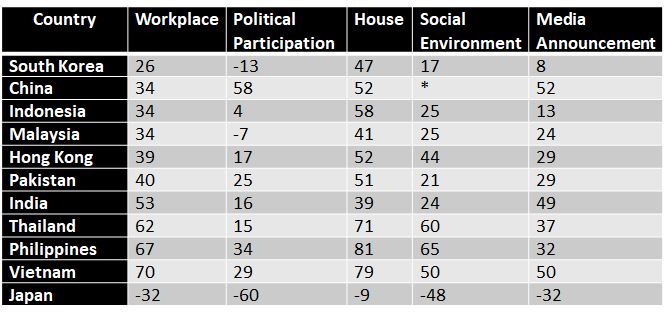
This article focuses on the Asia Pacific region, such as China, Hong Kong, India, Indonesia, Japan, Malaysia, Pakistan, the Philippines, South Korea, Thailand and Vietnam. To see the level of achievement of gender equality, the numbers that approve gender equality are higher than those who disagree. Then the response to agree or not is combined into a country’s net index.
This ranking shows, developed countries in the Asia Pacific region such as Japan actually have the lowest levels of achieving gender equality. While South Korea achieved the highest gender equality in the workplace, Indonesia was highest in political participation, South Korea was highest in the social environment and media coverage.
The perception of equality of workers’ wages according to women is still not ideal. It is possible that the patriarchal mind is still enduring, which considers men to work and bear the lives of women (in this case as a couple) and family.
However, women who work also are still trapped in these thoughts. So that not all women who work really empower themselves with their salaries. In this case career paths, promotion of positions, publication of works, and being an influential woman in the workplace.
Of the total world population in 2019, around 50% agree that men should get more wages, but only 5% agree that women should get more wages. Fortunately, around 39% of respondents agreed that both genders received equal wages.
In terms of gender, 46% of men agree if they have to get more wages, but there are also 43% who agree if men and women get equal pay. From the woman’s side, there are 54% who agree that men get more wages, but also 35% agree if women and men are equal.
The perception of pay equality in this article focuses on Asia Pacific, as mentioned in point (A). The data shows that the assumption that men should get more wages is still higher than the equivalent of men and women.
The countries with the highest inequality were South Korea (60%), Japan (56%), and Pakistan (49%). Contrast with Vietnam (72%), the Philippines (71%), India (66%), Thailand (62%), Hong Kong (56%), Indonesia (55%), and Malaysia (54%).
If dissected, developed countries in Asia Pacific such as South Korea and Japan still impose a wage gap based on gender. Unlike Indonesia, which is still a developing country, there is still an assumption of equal pay regardless of gender.
Source: Deka Insight and WIN Research survey (International Organization for independent market research)